

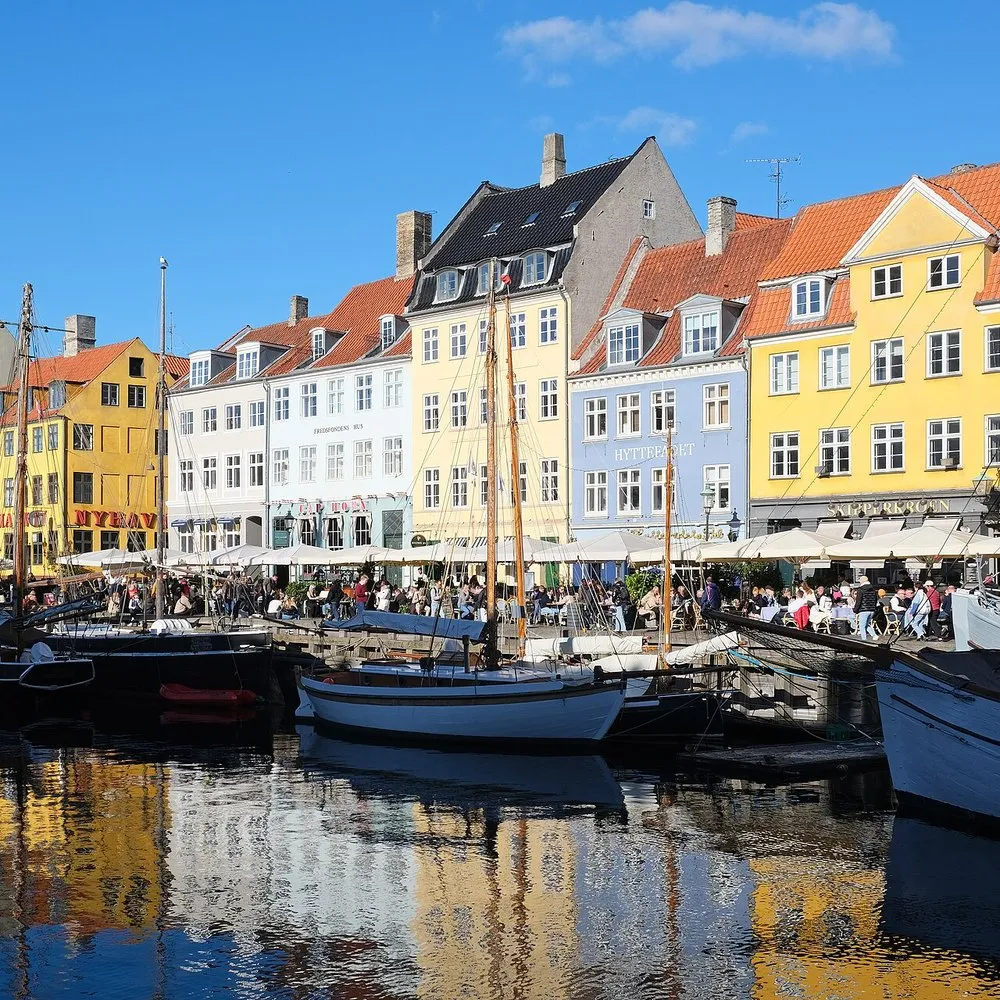

Why study in Denmark?
A different way of learning
Applying critical thinking, working with others and being creative are core values in Danish higher education. You are expected to take part actively in your studies, work with other students and share your own views.
A wide choice of English-taught programmes
Danish universities, university colleges and business academies offer more than 500 English-taught programmes, from engineering, computer science and business to the life sciences and social sciences.
Work during and after your studies
With a residence permit for a state-approved programme, you can work up to 90 hours a month from September to May and full time in June, July and August. After you graduate you can stay on to look for a job under a job-seeking permit – see below for the rules that changed on 1 October 2026.
Rules as of October 2026 — sources: Study in Denmark – Education in Denmark, Study in Denmark – student jobs.
The education system
Higher education in Denmark is offered by five types of institutions:
- Universities – research-based bachelor’s, master’s and PhD programmes
- University colleges – professional bachelor’s programmes in fields such as business, education, nursing and engineering
- Business academies – practical, career-focused Academy Profession (AP) degrees and top-up programmes
- Artistic higher education institutions – programmes in the arts, design and architecture
- Schools of maritime education and training
Denmark uses the European Credit Transfer and Accumulation System (ECTS): one year of full-time study is 60 ECTS credits.
| Qualification | Typical duration |
|---|---|
| Academy Profession (AP) degree | 2 years (120 ECTS) |
| Professional bachelor’s degree | 3 to 4½ years (180–270 ECTS) |
| Bachelor’s degree (BSc/BA) | 3 years (180 ECTS) |
| Master’s degree (Candidatus, MSc/MA) | 2 years (120 ECTS) |
| PhD | 3 years (180 ECTS) |
Since 2021 universities can also offer some one-year research-based master’s programmes of 60 ECTS. A two-year master’s includes a master’s thesis of at least 30 ECTS. Some AP graduates can go on to a professional bachelor’s degree in the same field through a top-up programme.
Figures as of October 2026 — sources: Study in Denmark – what can I study?, undergraduate studies.
State-approved programmes
Check that your programme is approved by a Danish state authority. As of October 2026, students on programmes that are not state-approved (and who applied on or after 2 May 2025) get no right to work while studying and no job-seeking permit after graduation. Ask your institution to confirm the status of your programme before you apply.
Rules as of October 2026 — source: SIRI – higher educational programmes.
Popular universities
- University of Copenhagen, Copenhagen
- Technical University of Denmark (DTU), Kongens Lyngby
- Aarhus University, Aarhus
- Aalborg University, Aalborg and Copenhagen
- University of Southern Denmark (SDU), Odense and other campuses
- Copenhagen Business School (CBS), Frederiksberg
- Roskilde University, Roskilde
- IT University of Copenhagen, Copenhagen
Entry requirements
Every institution sets its own academic and English requirements, and they vary by programme.
Master’s studies
- Academic background: a relevant, recognised bachelor’s degree equivalent in level and length to a Danish bachelor’s (180 ECTS). The university assesses your Indian degree and checks that the subjects you studied match the programme’s specific requirements – for example, a minimum number of credits in mathematics or programming.
- How to apply: directly to the university, through its own online application portal, with your degree certificates, transcripts, English test score and other documents it asks for.
- Deadlines: set by each university and often earlier for non-EU applicants. For example, some University of Copenhagen programmes close on 15 January for non-EU/EEA applicants, while many other programmes close on 1 February or 1 March for an autumn start.
Bachelor’s studies
Applications for bachelor’s, professional bachelor’s and AP programmes go through the national portal, optagelse.dk. You can apply for up to 8 programmes. Applicants with non-Danish qualifications must apply by 15 March at 12 noon (CET), and you hear back on 28 July. Each institution decides whether your Class 12 results meet its requirements.
Process as of October 2026 — sources: Study in Denmark – how to apply, undergraduate studies, Study in Denmark programme search.
English requirements
Most English-taught programmes ask for English at the Danish “English B” level (some ask for the higher “English A”), shown with a test such as IELTS Academic or TOEFL iBT. As an example, the University of Copenhagen’s English B requirement for master’s programmes is:
- IELTS Academic: 6.5 overall, with at least 6.0 in each section
- TOEFL iBT: 83 overall, with at least 20 in each section (on the older 0–120 scale)
The University of Copenhagen does not accept a bachelor’s degree taught in English as proof of your English and does not offer waivers. Accepted tests and scores differ between universities, so always check your programme’s own language page.
Requirements as of October 2026 — source: University of Copenhagen – language requirements for master’s programmes.
Scholarships
The main public scheme is the Danish Government Scholarships for highly qualified non-EU/EEA students. They are administered by each university, which selects its own recipients. A scholarship can be a full or partial tuition fee waiver and/or a grant towards living costs.
- Who can get one: citizens of countries outside the EU, EEA and Switzerland who are admitted to a full-degree programme and hold a time-limited Danish residence permit for study
- Not covered: students at artistic higher education institutions
- How to apply: through your university – read its admission and scholarship pages, as each university sets its own process and deadlines
Scholarships are limited and competitive, and many cover only part of your costs.
As of October 2026 — source: Study in Denmark – scholarships.
Education and living costs
Higher education is free for students from the EU, EEA and Switzerland, but Indian students pay tuition fees. As a guide, annual tuition for full-degree non-EU students is about DKK 45,000–120,000 (about €6,000–16,000). Fees depend on the institution and programme, so check the programme page. Some universities also charge non-EU applicants an application fee – for example, the University of Copenhagen charges a deposit of DKK 1,120 per application round for master’s applicants from outside the EU/EEA, which is generally not refunded.
Study in Denmark gives this rough monthly budget for a student:
| Expense | Approximate monthly cost |
|---|---|
| Rent (utilities usually included) | DKK 3,000–6,500 |
| Food | DKK 2,000–3,500 |
| Books and supplies | DKK 400–650 |
| Transport | DKK 300 |
| Insurance | about DKK 300 |
| Mobile phone | DKK 250 |
| Other personal expenses | DKK 2,000 |
That adds up to about DKK 8,500–14,000 a month, depending mainly on your rent.
Funds for your residence permit
For the residence permit you must show that you can support yourself: DKK 7,426 for each month of study, up to DKK 89,112 for 12 months for stays longer than a year (2026 level). Proof can be a bank statement in your own name, dated no more than 30 days before you apply, or a scholarship or student loan granted to you. Statements in another person’s name, and stocks, bonds or investment portfolios, are not accepted. You and your family cannot receive Danish public benefits such as the State Educational Grant (SU).
Figures as of October 2026 — sources: Study in Denmark – tuition fees, bank and budget, University of Copenhagen – tuition fees, SIRI – higher educational programmes.
Working while you study and after graduation
While you study
If you study on a state-approved programme, your residence permit includes a limited work permit:
- up to 90 hours a month from September to May, counted per calendar month; and
- full time in June, July and August.
Your residence card shows your own work conditions. If an internship is a compulsory part of your programme, you are automatically given a full-time work permit for that period. Working more than you are allowed is illegal and can lead to a fine or the loss of your permit.
After you graduate
Graduates of state-approved programmes are usually granted a job-seeking residence permit together with their study permit. How long it lasts depends on when you applied for your study permit:
- Applied on or after 1 October 2026: generally up to 1 year after you complete a bachelor’s, professional bachelor’s or master’s programme (6 months for a master’s for working professionals).
- Applied before 1 October 2026: generally up to 3 years.
- PhD students: up to 3 years, unchanged.
During the job-seeking period you have the same work rights as a student. Graduates of state-approved bachelor’s, professional bachelor’s and master’s programmes can also apply for an unrestricted work permit for the job-seeking period, without needing a job offer. To stay after that, you need a work-based residence permit, for example on the basis of a job offer. You must keep your address in Denmark and not stay abroad for more than 6 months in a row, or the permit lapses.
The older “establishment card” scheme for graduates has been abolished; only existing cards can be extended.
Rules as of October 2026 — sources: SIRI – higher educational programmes, SIRI – new rules for students from 1 October 2026, SIRI – job-seeking permit, SIRI – work permit during job seeking, SIRI – changes from 1 April 2023.
Residence permit for studies
As an Indian student on a programme longer than three months, you need a residence permit for studies from the Danish Agency for International Recruitment and Integration (SIRI). You must be admitted to a full-time higher education programme – you cannot get a permit to study part time.
How to apply
- Create a case order ID and pay the fee on nyidanmark.dk. The processing fee is DKK 3,060. Keep the payment receipt or a bank statement – a screenshot of the payment status on the website is not accepted.
- Your university completes its part of the online application form ST1, entering your email address. You then get an email with a link to sign up and complete your own part, which takes about 30–40 minutes.
- Upload your documents, including the fee receipt, a copy of every page of your passport (including blank pages and covers) and proof of funds.
- Give your biometrics (fingerprints and a facial photo) within 14 days of submitting online. In India, long-term applications and biometrics are handled by the VFS Global Denmark application centres, which include New Delhi, Mumbai, Chennai, Bengaluru, Hyderabad, Kolkata, Cochin, Pune, Ahmedabad and Chandigarh. Bring your application confirmation letter (which shows your case order ID) and your original passport. If you refuse biometrics, your application is rejected.
- Wait for the decision. SIRI’s normal processing time is 2 months, and up to 3 months if it needs more information, so apply as soon as you have your admission letter.
Points to note
- Passport validity: your permit can be valid only until 3 months before your passport expires, so renew your passport first if it expires soon.
- Family: if you apply on or after 1 October 2026 for a state-approved bachelor’s or master’s programme, your spouse, partner and children generally cannot get residence permits to join you.
- Under 18: both parents must sign a declaration of consent, and you need proof of custody, such as your birth certificate and your parents’ passport data pages.
- Changing programme: you need a new permit if you change to a different programme.
- Time abroad: your permit lapses if you stay outside Denmark for more than 6 months in a row, unless you get a dispensation.
Process as of October 2026 — sources: SIRI – higher educational programmes, SIRI – new rules for students from 1 October 2026, VFS Global – Denmark in India.
 USA
USA UK
UK Ireland
 Canada
 Australia
 New Zealand
 Germany
 France
 Switzerland
 Sweden
 Finland
 Singapore
 Dubai
Dubai