

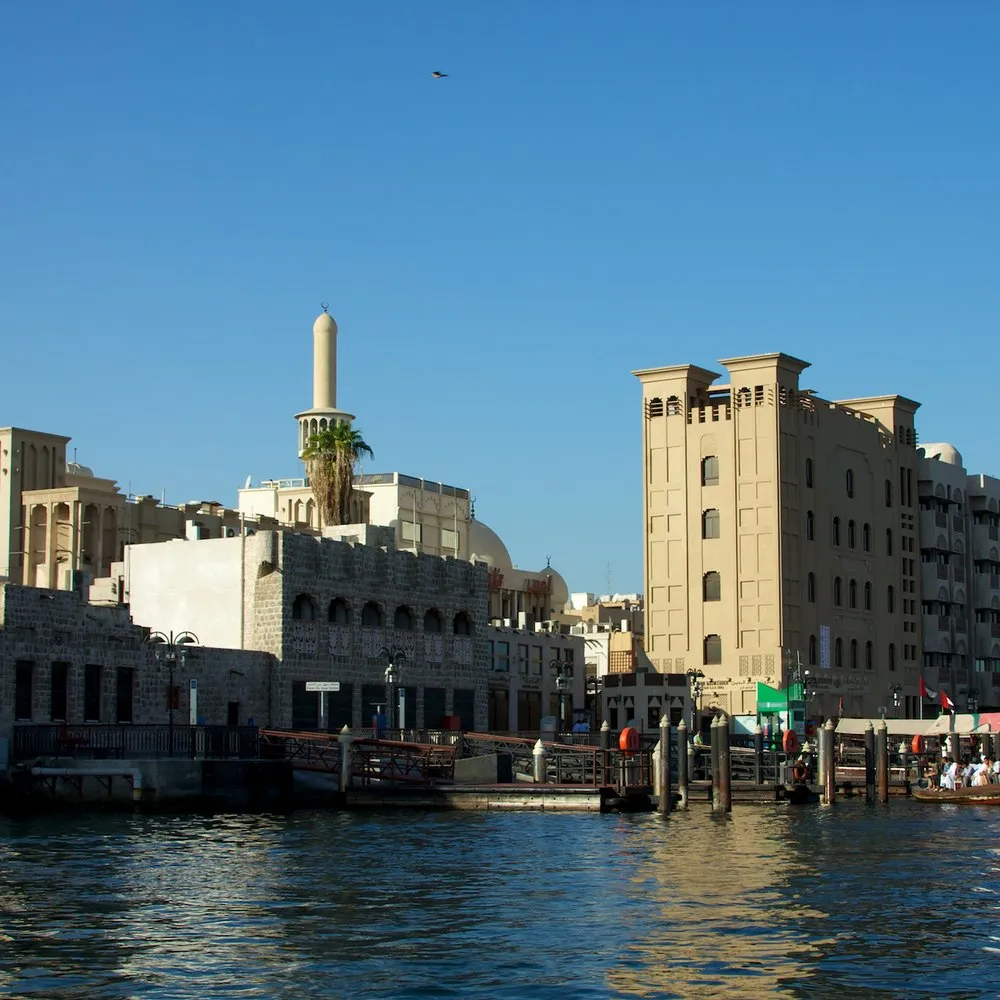

Why study in Dubai?
International degrees close to home
Dubai has become a major centre for international higher education. According to the Knowledge and Human Development Authority (KHDA), Dubai had 41 international higher education providers in 2024-25, 37 of them international branch campuses, with 42,026 students enrolled – the highest number to date. New campuses continue to open: the Indian Institute of Management Ahmedabad, the American University of Beirut and Fakeeh College for Medical Sciences were announced for the 2025-26 academic year.
At a branch campus you study for a degree awarded by the home university – in the UK, Australia, India or elsewhere – while living in Dubai.
Figures as of October 2026 — source: Dubai Media Office – KHDA higher education figures, July 2025.
Close to India
Dubai is a short flight from most major Indian cities and has a large Indian community, so many families find it easier to visit and to support their son or daughter than in more distant destinations.
Shorter Master’s programmes
Many UK branch campuses offer one-year, full-time Master’s programmes, just as in the UK, with September and, for some programmes, January starts. Part-time options are also common.
The education system
Higher education in Dubai is regulated at two levels, and it is important to understand both before you choose a university.
- Federal level – the Ministry of Higher Education and Scientific Research (MoHESR). Through its Commission for Academic Accreditation (CAA), the Ministry licenses institutions and accredits programmes across the UAE. Universities outside Dubai’s free zones are licensed in this way.
- Dubai’s free zones – the KHDA. Many international branch campuses are in free zones such as Dubai International Academic City and Dubai Knowledge Park. These institutions are permitted by the KHDA. For branch campuses, KHDA’s quality assurance checks that the programmes delivered in Dubai match those at the home campus. Graduates of free-zone institutions can have their degrees certified (attested) by the KHDA for employment and other purposes in Dubai.
- Joint licensing. In January 2025 the Ministry and the KHDA agreed to streamline licensing in Dubai, and in February 2025 the Ministry licensed 16 Dubai institutions, including free-zone branch campuses such as Middlesex University Dubai, Murdoch University Dubai, Curtin University, the University of Manchester, BITS Pilani Dubai Campus and Manipal Academy of Higher Education. The Ministry says this allows students at those institutions to obtain Ministry approval for their certificates and transcripts.
Rules as of October 2026 — sources: MoHESR – 16 institutions licensed in Dubai (February 2025), KHDA – FAQs on universities in Dubai, WAM – MoHESR and KHDA partnership.
Checking recognition – especially if you will return to India
Before you apply, check three things:
- Licensing in Dubai and the UAE. Look the institution up in the KHDA and Ministry directories, and confirm whether your exact programme is covered. Recognition can matter later, for example for government jobs or professional licensing in the UAE.
- Recognition in the home country. For a branch campus, ask whether the degree certificate and transcript are the same as at the home campus, and how the programme is accredited in the university’s home country.
- Recognition in India. Since April 2025, the University Grants Commission (UGC) grants equivalence to foreign qualifications under its own regulations, through an online portal. A qualification from the off-shore campus of a foreign university can be recognised if the campus is approved by the competent authority both in the country where it is located and in the university’s home country, and the programme meets accreditation requirements in both. A qualification obtained through a franchising arrangement is not considered for equivalence. These regulations do not cover professional qualifications such as medicine, pharmacy, nursing, law and architecture, which follow the norms of the relevant councils in India.
For the Dubai campuses of Indian universities, the degree is awarded by the Indian parent university; ask the university in writing how the qualification is treated in India for jobs and further study.
Rules as of October 2026 — source: UGC (Recognition and Grant of Equivalence to Qualifications obtained from Foreign Educational Institutions) Regulations, 2025 – Gazette of India, 4 April 2025.
Popular universities and branch campuses
- University of Birmingham Dubai (UK)
- Heriot-Watt University Dubai (UK)
- Middlesex University Dubai (UK)
- University of Manchester – Dubai centre (UK)
- University of Wollongong in Dubai (Australia)
- Curtin University Dubai (Australia)
- Murdoch University Dubai (Australia)
- BITS Pilani Dubai Campus (India)
- Manipal Academy of Higher Education, Dubai (India)
- American University in Dubai
Entry requirements
Master’s studies
You will usually need a recognised bachelor’s degree in a relevant subject. Requirements depend on the university and programme. For example, Heriot-Watt University Dubai asks Indian applicants for most postgraduate subjects for the equivalent of a UK 2:2 – 55% or a CGPA of 5.5 out of 10 – and more for some programmes. Business and management programmes may ask for work experience, and an MBA usually does.
Bachelor’s studies
For undergraduate entry you will need your Class 12 results. For example, Heriot-Watt University Dubai asks for 65% overall in Class 12 (CBSE, ICSE or state boards) for most first-year programmes, with subject requirements for engineering and computer science. Some universities offer a foundation year if you do not meet direct entry.
Requirements as of October 2026 — source: Heriot-Watt University Dubai – international entry requirements.
English requirements
Teaching at branch campuses is in English, so you will need to show your English level. Most universities accept IELTS Academic, TOEFL iBT and PTE Academic, and scores usually must be less than two years old when your course starts. For example, at the University of Birmingham Dubai, postgraduate programmes ask for:
| Programme group | IELTS Academic | PTE Academic |
|---|---|---|
| Engineering, Computer Science, Mathematics, Urban Planning | 6.0 overall, no band below 5.5 | 64, with 59 in each skill |
| Business, Education, Health Sciences, Psychology and other subjects | 6.5 overall, no band below 6.0 | 67, with 64 in each skill |
Birmingham Dubai also accepts Class 12 English for postgraduate entry: 75% or above for CBSE, CISCE or West Bengal boards, and 80% or above for other Indian state boards. Not every university accepts Class 12 marks, so always check the programme page.
Requirements as of October 2026 — source: University of Birmingham Dubai – English language requirements.
Scholarships
Most scholarships in Dubai are university merit awards, given as a percentage off tuition. Examples:
- Heriot-Watt University Dubai – Postgraduate Merit Scholarship: 10% for an Indian bachelor’s degree with a CGPA of 7 out of 10 or 70%, and 15% for a CGPA of 7.5 out of 10 or 75%. Awards are assessed case by case.
- University of Birmingham Dubai – Postgraduate Chancellor’s Academic Merit Scholarship: up to 30% of tuition a year for outstanding academic achievement. Eligible applicants are considered automatically when they apply.
Scholarships usually cover only part of the tuition, often cannot be combined, and may have conditions such as a minimum grade to keep them.
Scholarships as of October 2026 — sources: Heriot-Watt Dubai – Postgraduate Merit Scholarship, University of Birmingham Dubai – scholarships.
Education and living costs
Tuition depends strongly on the university and programme. As examples of full-time Master’s fees per year, VAT included:
| University and programme | Approximate tuition per year |
|---|---|
| University of Birmingham Dubai – MSc programmes (September 2026) | about AED 139,000 to AED 175,000 |
| Heriot-Watt University Dubai – MSc programmes (2027 intakes) | about AED 99,500 to AED 172,500 |
Universities also charge application fees and a tuition deposit when you accept your offer; at Birmingham Dubai, for example, the tuition deposit is AED 5,000 and is deducted from your tuition. Fees usually rise each year, so always check the course page.
Living costs
The University of Birmingham Dubai estimates about AED 6,860 a month for a student living in a single room, not counting visa costs:
| Expense | Approximate cost per month |
|---|---|
| Rent (single room, full-year contract) | AED 4,600 |
| Groceries | AED 1,000 |
| Recreation and entertainment | AED 600 |
| Mobile | AED 160 |
| Taxis | AED 500 |
Sharing a room and using university buses instead of taxis can lower your costs. For example, at The Myriad, a partner residence in Dubai, a shared double room for 9–12 months costs AED 3,250 a month per person in 2026/27, with utilities and Wi-Fi included.
Figures as of October 2026 — sources: Birmingham Dubai – course fees, e.g. Data Science MSc, Sport and Exercise Medicine MSc, fees and deposit, cost of living, The Myriad; Heriot-Watt Dubai – MSc Finance and Management, MSc Petroleum Engineering.
Working while you study and after graduation
While you study
A student residence visa is for study: it does not by itself allow you to work. To work or train, an employer must obtain a Student Training and Employment Permit from the Ministry of Human Resources and Emiratisation (MOHRE). You will need a valid UAE residence visa and Emirates ID, and for training your university’s no-objection certificate. The permit is valid for three months. Your university may set its own rules, so speak to student services before you take any job – working without a permit can put your visa at risk.
Do not plan to pay your tuition or living costs from part-time work.
After you graduate
- Employer-sponsored work visa. Most graduates who stay on do so by finding a job with an employer who sponsors their work permit and residence visa.
- Jobseeker visit visa. You can look for work in the UAE on a 60-, 90- or 120-day jobseeker visit visa without a sponsor. You need a bachelor’s degree or equivalent and must either work at MOHRE skill levels 1 to 3 or have graduated in the last two years from one of the world’s top 500 universities, as classified by the Ministry. A financial guarantee is required.
- Green Visa for skilled employees. A five-year, self-sponsored residence visa for skilled employees with a valid employment contract, a bachelor’s degree, a job at MOHRE skill levels 1 to 3 and a monthly salary of at least AED 15,000.
- Golden Visa for outstanding graduates. Top-performing graduates of UAE universities can apply for a 10-year Golden Visa within two years of graduating. The university must be in the Ministry’s Category A (minimum cumulative GPA 3.5 out of 4) or Category B (minimum GPA 3.8 out of 4), and the degree must be attested by the Ministry.
Rules as of October 2026 — sources: MOHRE – Student Training and Employment Permit, u.ae – jobseeker visit visa, ICP – Green Residency, ICP – Golden Residency.
Student visa and residence
Indian students need a UAE student residence visa. You do not apply at a UAE embassy in India: for most international students the university sponsors the visa and applies to the UAE immigration authorities for you (in Dubai, the General Directorate of Residency and Foreigners Affairs, GDRFA). A student can also stay under the sponsorship of a parent who is a UAE resident.
How it works
- Register with your university after accepting your offer, and complete its visa application form with your passport, photo and other documents.
- Pay the university’s visa fees. These differ widely: for example, BITS Pilani Dubai Campus charges AED 2,900 for a new visa, while the University of Birmingham Dubai’s total for students applying from outside the UAE is about AED 7,068 at the normal speed, including a refundable AED 3,000 visa deposit and medical insurance.
- Receive your entry permit. Do not book flights until it is issued. Bring a printed copy when you travel.
- Medical fitness test and biometrics. After you arrive, you attend a medical test and give your fingerprints for the Emirates ID. If you are declared medically unfit, the visa cannot be issued.
- Residence visa and Emirates ID. Your residence visa is issued for one year and your Emirates ID card is delivered. The whole process can take several weeks after arrival.
Health insurance that meets Dubai Health Authority rules is compulsory. You renew the visa each year while you remain enrolled, and it can become invalid if you stay outside the UAE for more than 180 consecutive days.
Process as of October 2026 — sources: u.ae – residence visa for studying in the UAE, University of Birmingham Dubai – student visas and applying for a new visa, BITS Pilani Dubai – student residence visa terms.
 USA
USA UK
UK Ireland
 Canada
 Australia
 New Zealand
 Germany
 France
 Switzerland
 Sweden
 Finland
 Denmark
 Singapore